ONLINE MEDIA - Website
Tragedy and Hauntings at Ghost Base CFB Rivers
Collection: Virtual Manitoba (Miscellaneous)

Air Force Training Centre | Chapter 2
Related Collection: Virtual Manitoba (Miscellaneous)
Air navigator training began in Canada in 1936 at RCAF Station Trenton.1[1] Very few navigators were trained prior to the Second World War, however the creation of the British Commonwealth Air Training Plan (BCATP) on 17 December 1939 had a dramatic impact on this situation. Specialist training expanded at a tremendous rate, resulting in the graduation of over thirty thousand Navigators from the BCATP,2[2] over twelve thousand of them Canadian.3[3] From that humble beginning, the navigator classification in Canada has grown tremendously, in terms of technology, aircraft, roles, and especially training.
The Canadian Forces Air Navigation School (CFANS) is the basic aircrew training facility for all Canadian navigators, as well as navigators from seven other NATO and non- NATO countries.4[4] CFANS has existed in its current form in Winnipeg since 1968, but air navigator training in Canada has been anything but constant. The wheel has been re-invented many times over the last 65 years, with name, location, syllabus, and aircraft changes. Navigator training in Canada has just taken a major leap forward with the introduction of a desktop- computer based simulator, called the Tactical Mission Trainer (TMT), which will allow navigator students to use the same computer software in the simulator that they will use in the aircraft. This has never been done training anywhere in the world, largely because aircraft and simulators have not been software-driven until very recently. This simulator will vastly improve navigator training, and will help students develop the skills needed to perform today’s navigator role. The roles of the navigator have also changed significantly in the last 65 years. Navigation using a watch and a map has been replaced with advanced navigation computers like the Global Positioning System (GPS)5[5] and Inertial Navigation Systems (INS).6[6] GPS and INS have taken the guesswork out of navigating, and allowed the navigator to focus on mission and crew management.
The school in Trenton, Ontario where navigators were trained prior to the Second World War was called the Air Navigation and Seaplane School. The name of the school was changed to the Air Navigation and Reconnaissance School, and was changed again to No. 1 Air Navigation School (1 ANS) on 2 September 1940.7[7] The purpose of 1 ANS was to teach advanced navigation to air observers who had graduated from bombing and gunnery schools. The school had been originally intended to open at Rivers, Manitoba; however, construction delays there forced it to remain at Trenton. The school consisted of 227 military and 95 civilian personnel, and flew Avro Anson aircraft. The commanding officer of 1 ANS was Flight Lieutenant F.R. Miller. The completion of construction at Rivers allowed 1 ANS to move west in November 1940. By February of 1941, the staff had grown to 56 officers and 424 airmen. A month later, the first of the Commonwealth trainees arrived in Rivers from Australia and New Zealand.
The increase in bombing missions in Europe caused the demand for air observers to grow in 1941, and 2 ANS was formed at Pennfield Ridge, New Brunswick in July of that year. The two schools operated separately for a year before their amalgamation into the Central Navigation School (CNS). The decision to merge the schools was made for economic reasons, as well as the belief that meteorological conditions in Manitoba were preferable for celestial navigation training. No. 2 ANS moved to Rivers in May 1942, and 1 CNS was created under the command of Group Captain A. Lewis. In July of 1942, the staff at 1 CNS consisted of 103 officers, 1932 airmen, and 248 civilians, with an additional 90 officers and 595 airmen as students. They operated 118 Avro Ansons (Figure 1) and one Stinson HW-75 (Figure 2) aircraft.8[8]
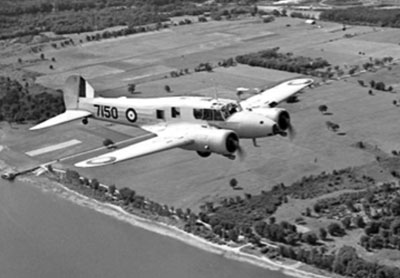
Avro Anson
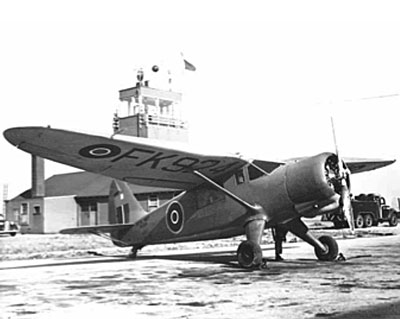
Stinson HW 75
Operations at Rivers concluded in August of 1945 with the end of the war. No. 1 CNS disbanded on 15 September 1945. These two schools, 1 ANS and 1 CNS, trained 11,406 navigators on behalf of the BCATP.9[9]
In addition to the military navigation schools, there were ten civilian operated observer/navigator schools in Canada during the war – suitably designated No.1 through No. 10.10[10] These schools opened between May 1940 and September 1941, and the majority closed in April 1945. All used Avro Anson aircraft and civilian pilots. The busiest of these civilian training facilities was No. 7 Air Observer School (7 AOS) in Portage-la-Prairie, Manitoba. It graduated over 5000 navigators11[11]. Following the war, No. 3 Air Navigation School opened at Portage. This number of graduates in a five-year period is extraordinary given the weather conditions endured year-round. Winters were harsh, and the aircraft did not have the advanced anti-icing equipment of modern aircraft. Spring and autumn were no easier, with heavy rainfall leading to mud-caked runways. In comparison, CFANS will graduate approximately 40 students this year12[12], using four advanced navigation training aircraft with full de-icing and anti-icing capabilities, plus an air-search radar to avoid weather. No. 7 AOS used 25 Anson aircraft with no de-icing or anti-icing capability and no radar. Staff still graduated over four times the number of students CFANS could with the same number of planes. These numbers are difficult to compare, however, as the role of the navigator was much different. There was no data available on the syllabus of these schools, however looking back it would seem to be much more basic than navigator training today. The output of navigators was still impressive given the conditions. This is only one example of the ten civilian-run observer schools in Canada during the Second World War. The conditions experienced at each one would be comparable, as would be the efforts of the civilian pilots and military instructors.
With ten civilian and five military-run navigator/observer schools, the biggest challenge would have been to maintain an acceptable standard of instruction. CFANS has difficulty maintaining standardization of training and evaluation today, with only thirty instructors and forty to fifty students per year. The difficulty of maintaining standardization among fifteen schools and thousands of students must have been very difficult. There was no statistical data available to properly analyze student performance against the set standard of the time. Most likely the students would have had to demonstrate an ability to adapt to the air and provide suitable navigation. With the demand for navigators being so high, the standards required may have slipped at the schools, with the instructors expecting further training to be provided in theatre. In addition to student standards, instructor standards would have been difficult to maintain, as instructors are usually chosen by seniority or personality rather than instructional ability.13[13] Instructors today are chosen in the same manner, based on experience in the field of navigation. This does not always translate to good instructional ability; however, there have been huge advances in the study of human behaviour and how people learn. New instructors at CFANS are given a dedicated three-month course of instructional styles and learning types.14[14] It is doubtful whether there would have been time to run such a course during the war.
The wartime syllabus of navigator training was composed of deduced reckoning, map reading, graphical air plot, and celestial navigation. Given the nature of the missions flown during the war, i.e. bombing and reconnaissance missions, the navigator would need all of these skills to get to and from the target. Various methods of expressing position were taught, for example latitude and longitude, and the grid system. The grid system, still used today, consisted of dividing a map into equal sized squares and labeling them. This system allowed navigators to express position easily between aircraft, without relying on complex names or directions.15[15] The missions flown in the Second World War were almost exclusively large-scale bombing raids, where geographical features were used for navigation. The navigator in the lead aircraft was responsible for guiding the entire squadron. The use of a grid system to express position rather than explaining terrain features would have greatly reduced confusion among the aircraft. If weather did not permit visual navigation, deduced reckoning and air plot were used. Night missions relied on celestial navigation; therefore cloud cover would have made finding the target nearly impossible.
Training over the prairies for bombing and reconnaissance missions over the English Channel and Europe was good from a weather standpoint, but not from an operational standpoint. Royal Air Force (RAF) Air Vice Marshall D.C.T. Bennett, who founded the Pathfinder Group of Bomber Command, and helped establish the trans-Atlantic ferry organization during the war, was asked about navigation training in the BCATP. His reply was “it was very sound but it was training and you cannot duplicate real experience in training.”16[16] Air Vice Marshall Bennett felt that newly graduated navigators who flew over to Europe rather than sailing on a ship gained valuable experience and were therefore more valuable assets. His opinion of the BCATP-trained navigators was that they “…were basically sound…”17[17] That may sound like faint praise, however it is one of the warmer sentiments ever uttered by an RAF senior officer.
After the Second World War ended, all observer and navigator schools were disbanded, as there was no longer a need for new navigator trainees. The specialist wing of 1 CNS was the only section that survived the post-war disbandment. This group was moved to Summerside, PEI, to form the basis of a new Air Navigation School (1 ANS). This new school graduated two courses of navigator instructors during 1945-1946. Training then ceased at 1 ANS for 18 months pending research on the best direction to take navigation training in Canada. Royal Canadian Air Force (RCAF) training in the specialty recommenced in 1948 with the first Staff Navigator Instructor Course (SNIC) followed by the first specialist navigator course.18[18] The Korean War and Canada’s increased commitment to NATO created a demand for more navigators. A second Air Navigation School (2 ANS) opened in Winnipeg in 1951. In January 1952, 2 ANS had 600 students and over 100 Beechcraft Expeditor aircraft. The majority of the students at the time were RCAF and Royal Air Force (RAF). However, students from France, Belgium, Holland, Denmark, Portugal, Norway, Italy and Turkey also trained in Winnipeg.19[19] The Central Navigation School (CNS) was reborn in Summerside, with the added roles of standards, test, and evaluation in addition to instruction. Canada now had three navigation schools, two in Summerside and one in Winnipeg. Change and consolidation came with the closure of 1 ANS, Summerside, in 1953 and its incorporation into 2 ANS, Winnipeg. CNS remained at the Prince Edward Island station until 1954, when it too moved to Winnipeg.
In the early 1950’s, the basic navigation course lasted 22 weeks, comprising 781 hours of ground instruction and 150 hours of airborne instruction.20[20] The syllabus remained the same as the one used during the Second World War – with the aim of training prospective navigators to fly with confidence under any circumstances. Graphical air plot, where the aircraft’s position and heading are determined using mathematical vectors, was combined with celestial fixing to navigate the aircraft. Using an aircraft’s estimated position, the students would use celestial sight reduction tables21[21] to determine where to look for a particular star or celestial body. A sextant was used to look for the star, and the actual position of the celestial body in relation to the aircraft would determine the position of the aircraft over the earth. This type of navigation, which seems archaic by today’s standards, is quite accurate, and is still in limited use. In addition to navigation training, the students were being prepared to hold the Queen’s Commission. Officer professional training played a large role in the training of navigators, and still does today. There is a military adage that says “You are an Officer first, and a navigator second.22[22]”
The arrival of the CF-100 all-weather fighter caused a radical shift in navigator training. The course was split into a basic and advanced course. The basic course, discussed earlier, increased to 39 weeks to cover basic theoretical and practical navigation principles. The advanced course was further split into long-range (LR) navigation and airborne interception (AI) navigation. Basic navigator training was conducted in Winnipeg on the C-45 Expeditor (Figure 3) aircraft. All navigator students took the basic course, and then continued on to the advanced course in either AI or LR navigation. The basic course consisted of deduced reckoning (DR) navigation theory, where aircraft heading and ground speed were used to determine position, compass and instrument theory, electronics theory, meteorology, and celestial navigation.23[23]
ONLINE MEDIA - Website
Collection: Virtual Manitoba (Miscellaneous)
ONLINE MEDIA - Facebook Page
Collection: Virtual Manitoba (Miscellaneous)
ONLINE MEDIA - Website
Collection: Virtual Manitoba (Miscellaneous)
1[1] Canadian Forces Sentinel, Volume 5, 1975, p. 14.
2[2] Larry Milberry and Hugh Halliday, The Royal Canadian Air Force at War 1939-1945. (Toronto: CANAV Books, 1990) p. 28. The figure taken from the table is 29,963 including Navigators, Navigator (bomber) and Navigator (wireless) students.
3[3] W.A.B. Douglas, The Creation of a National Air Force: The Official History of the Royal Canadian Air Force Volume II. (Toronto: University of Toronto Press, 1986) p. 293. These figures were taken from the official report to the Chief of the Air Staff at the end of the War. These figures are also available from Milberry and Halliday, p. 28. Douglas’ figures are for RCAF graduates only; Milberry and Halliday’s cover all BCATP graduates.
4[4] CFANS currently has students from Singapore, Korea, and New Zealand, and is expecting to train students from Germany, Norway, Denmark and the Netherlands by the end of 2001.before in navigator
5[5] GPS is a navigation computer that uses the signals sent out by an American satellite constellation. The satellites send signals to aircraft GPS receivers, and the computer provides three-dimensional position information anywhere on the globe.
6[6] INS is a computer that can provide navigational information when initialized with a correct latitude and longitude. The system uses aircraft pitch, roll, and acceleration to calculate speed and direction to update the aircraft’s position.
7[7] Canadian Forces Sentinel, Volume 5, 1975, p. 14.
8[8] Information taken from CFANS historical files.
9[9] Canadian Forces Sentinel, Vol 5, 1975 p. 14.
10[10] Milberry, RCAF at War 1939-1945, p. 456
11[11] Ibid, p. 71
12[12] CFANS has a maximum capacity of 64 students per year, running 8 serials of 8 students. With an historical failure rate of 25%, that equals 48 graduates. Recent years have seen a decline in the number of students to 6 serials of 6 to 8 students, with approximately 40 graduates per year.
13[13] Earl L. Wiener and David C. Nagel, (editors). Human Factors in Aviation. (London: Academic Press Inc, 1988), p. 252.
14[14] The Flight Instructors Course (FIC) is detailed later in the paper 15[15] Canadian Air Publication 12, Part One, 2nd edition. Navigation chapter, p. 14.
16[16] F.J. Hatch, Aerodrome of Democracy: Canada and the British Commonwealth Air Training Plan 1939-1945. Ottawa: Directorate of History, 1983, p. 172.
17[17] Ibid, p. 172 & 173.
18[18] RCAF Navigation Bulletin, Vol. 1, No. 1, January 1949, p. 4. 19
[19] RCAF Navigation Bulletin, Vol. 7, No. 2, April 1955, p. 64. 20
[20]Canadian Forces Polaris Vol. 4, No.2, 1975 p. 7. Article written by Capt J.G. Parent.
21[21] Sight Reduction Tables are used to determine to position of a celestial body, using an aircraft’s estimated position as a starting point. The SRT will then tell the navigator where in the sky to look with his sextant, a type of telescope. The actual position of the celestial body in relation to the aircraft is used to calculate aircraft position.
22[22] A saying heard by every new navigator student at CFANS in the Officer Development syllabus. 23[23] Milberry, Sixty Years, p. 287